
Grief Is Not Just About Death
Grief Is Not Just About Death
Understanding The Many Losses We Experience Throughout Life
By Rachel Madar
When most people hear the word grief, they think of death.
The loss of a loved one.
A funeral.
A period of mourning.
And while grief certainly includes these experiences, grief is much larger than many of us realize.
In fact, some of the deepest grief we experience throughout life has nothing to do with death.
We grieve relationships.
We grieve dreams.
We grieve identities.
We grieve seasons of life.
We grieve the future we imagined.
We grieve who we used to be.
Yet because these losses are often invisible, many women do not recognize what they are experiencing.
Instead, they tell themselves:
"I shouldn't feel this way."
"Others have it worse."
"I should be over this by now."
"I don't understand why I'm so emotional."
The truth is often much simpler.
You may be grieving.
And grief deserves to be acknowledged.
No matter what form it takes.
The Many Faces Of Grief
Grief is the natural response to loss.
And loss comes in many forms.
A divorce.
A breakup.
An empty nest.
A health diagnosis.
Retirement.
A career change.
Financial hardship.
The loss of a friendship.
A move.
A spiritual crisis.
A dream that never came true.
The loss of youth.
The loss of certainty.
The loss of a version of yourself.
All of these experiences can create grief.
Because grief is not only about losing people.
It is about losing what mattered.
The Grief We Do Not Recognize
One of the most challenging aspects of non-death grief is that it often goes unacknowledged.
Others may not understand.
There is no ceremony.
No public mourning.
No clear timeline.
You continue going to work.
Taking care of responsibilities.
Showing up for others.
Yet internally, something has changed.
A chapter has ended.
A part of your life has disappeared.
And your heart is trying to adjust.
Without acknowledgment, grief often becomes loneliness.
Because we feel something deeply but lack the language to explain it.
Why Life Transitions Trigger Grief
Every major transition contains an ending.
Even positive transitions.
Children leaving home.
Retirement.
Moving to a new city.
A new relationship.
A new career.
A spiritual awakening.
Growth itself often requires letting go of something familiar.
And whenever something ends, grief naturally follows.
This does not mean the change is wrong.
It simply means something meaningful has shifted.
The Grief Of The Woman You Used To Be
One form of grief that many women experience in midlife is the grief of identity.
The woman you were twenty years ago no longer exists.
The mother of young children.
The newly married woman.
The woman at the beginning of her career.
The version of yourself who once held certain dreams.
As life evolves, identities evolve.
And while growth is beautiful, there can also be sadness.
Not because we want to go backward.
But because we recognize that a chapter has ended.
The Grief Of Unmet Expectations
Many women carry grief for things that never happened.
The relationship they hoped would heal.
The child they hoped to have.
The business they dreamed of building.
The future they imagined.
The love they expected.
The life they thought would unfold.
This type of grief is often overlooked because nothing tangible was lost.
Yet the heart still feels the absence.
The dream mattered.
The hope mattered.
And therefore the grief matters.
Why Grief Cannot Be Rushed
One of the greatest misunderstandings about grief is the belief that it follows a predictable timeline.
Many women ask:
"When will I be over this?"
The answer is different for everyone.
Healing is not a schedule.
It is a process.
Some days feel lighter.
Some days feel heavy.
Some memories bring tears.
Others bring gratitude.
Grief moves in waves.
And learning to move with those waves is part of healing.
What Grief Is Trying To Teach Us
Grief often reveals what we loved.
What mattered.
What was meaningful.
What shaped us.
What touched our hearts.
In this way, grief becomes an expression of love.
Not weakness.
Not failure.
Not something to fix.
But evidence that something mattered deeply.
And that deserves respect.
The Hidden Gifts Of Grief
While grief is painful, it often creates profound transformation.
It deepens compassion.
It strengthens resilience.
It clarifies priorities.
It softens judgment.
It increases empathy.
It reconnects us with what truly matters.
Many women later discover that grief changed them.
Not because they wanted the pain.
But because the experience invited them into a deeper relationship with themselves.
What If You Allowed Yourself To Grieve?
Many women spend years resisting grief.
Trying to stay strong.
Trying to move on.
Trying not to feel.
Yet healing often begins when we stop resisting.
What if you allowed yourself to acknowledge the loss?
To honor the sadness?
To create space for the emotions?
To trust that grief is not here to destroy you?
What if it is here to help your heart adapt to change?
Reflection Questions
Take a journal and explore:
What losses am I currently grieving?
Which losses have I never fully acknowledged?
What chapter of my life has ended?
What version of myself am I releasing?
What expectations am I grieving?
What has this loss taught me?
What support do I need right now?
Allow your answers to emerge gently.
Without judgment.
A Practice For Honoring Grief
Find a quiet place.
Place your hand over your heart.
Take several slow breaths.
Ask yourself:
"What loss needs acknowledgment today?"
Allow whatever arises.
Offer compassion to yourself.
Not solutions.
Not analysis.
Simply compassion.
Sometimes healing begins with being willing to sit beside our own pain.
A Final Thought
Grief is not a sign that something is wrong with you.
It is a sign that something mattered.
Something was loved.
Something was meaningful.
And now something has changed.
Whether you are grieving a person, a relationship, a dream, an identity, or a chapter of your life, your grief deserves space.
Your grief deserves kindness.
Your grief deserves understanding.
And most importantly, your grief deserves time.
Because healing is not about forgetting.
It is about learning how to carry the experience differently.
It is about allowing life to continue while honoring what has been.
And eventually, it is about discovering that even after loss, love remains.
Meaning remains.
Purpose remains.
And so do you.
Ready To Navigate Loss With Greater Compassion?
If you are experiencing grief, loss, divorce, or a major life transition, I invite you to explore The Next Chapter Experience™, CREATION: RE:SET™, or schedule a complimentary Discovery Call.
Together, we can honor what has been lost while creating space for healing, meaning, and the possibility of a new chapter.
Because grief is not the end of the story.
It is often the beginning of a deeper understanding of what it means to be fully alive.
With love,
Rachel Madar
Download the Healing & Renewal Reflection Guide and begin exploring the emotions, lessons, and possibilities that emerge through life's many transitions and losses.
Deepen this journey with a free workbook.
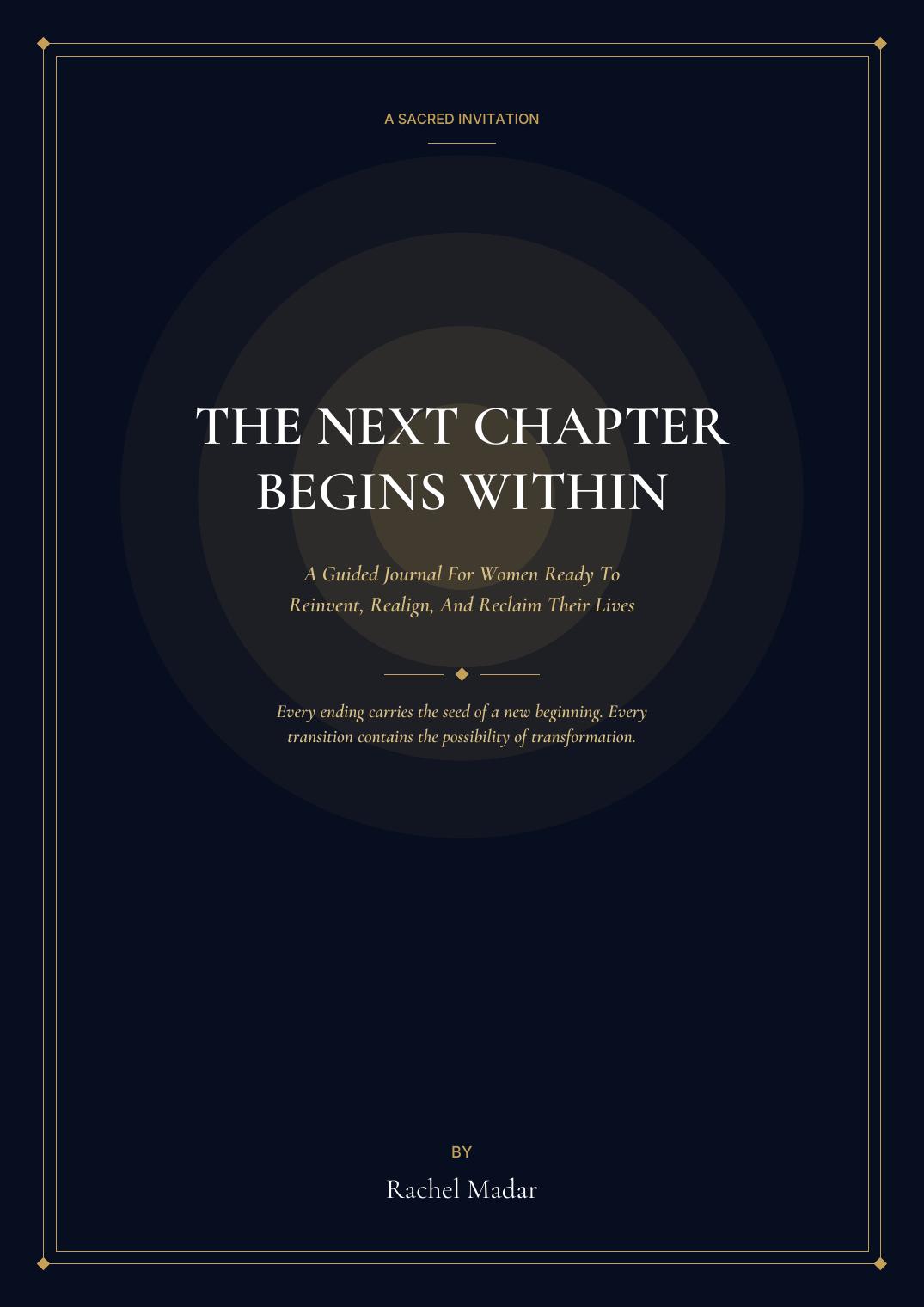
The Next Chapter Begins Within. A guided journal for women ready to reinvent, realign, and reclaim their lives. Reflection prompts to help you uncover what wants to emerge in this season of becoming.
Immediate delivery to your inbox · We respect your privacy.
More from the Journal
Finding Meaning During Times Of Change
And suddenly the life we knew no longer exists in the same…
How To Move Through Uncertainty With Grace
A new beginning emerges before we fully understand where it will…
How To Reinvent Yourself After 50
There comes a moment in many women's lives when they look around and realize something has…